
Learning communities " a workshop from the Quality Assurance Authority archive"
This report is from our 2018 archive. See what the Foundation does now.
Translated from Arabic. Read the original.
Good morning - quality, warmth and love
https://ww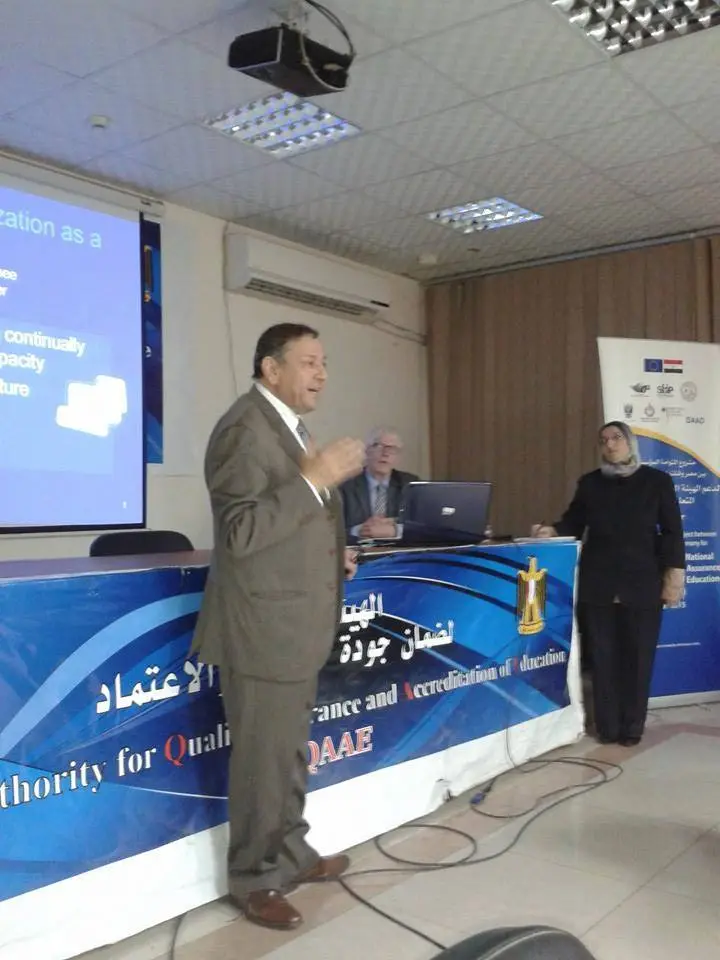
 w.facebook.com/mervat.maher.56/posts/10200886985122631
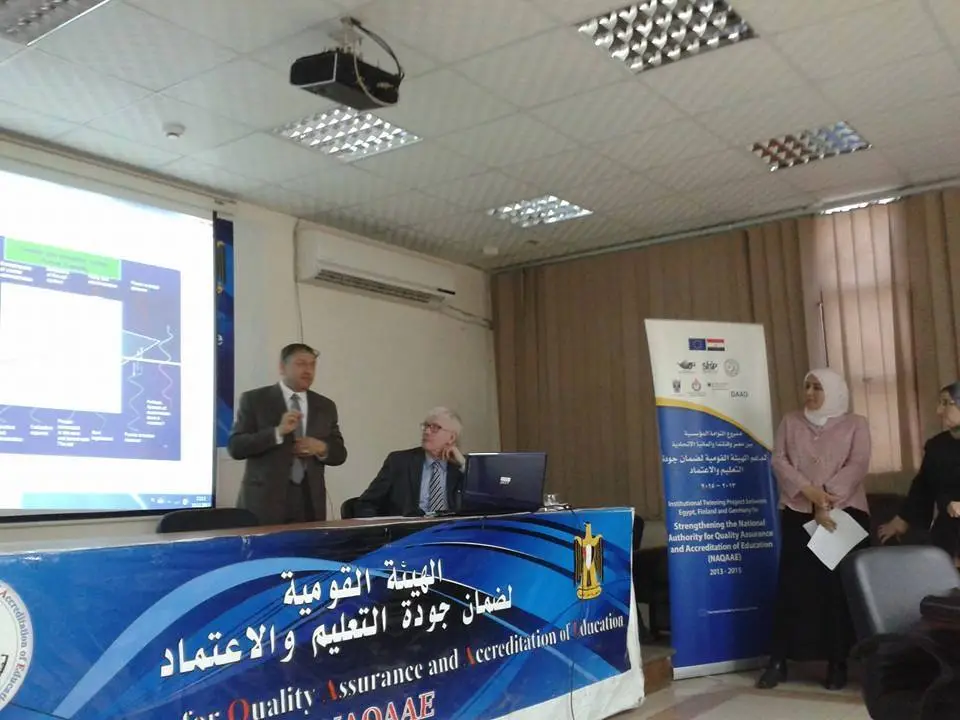
Workshop on Monday 9 December 2013 (twinning) between Egypt and the European Union – the National Authority for Quality Assurance and Accreditation of Education – the accreditation bodies of Finland as lead partner and Germany as junior partner
Venue: the National Authority for Quality Assurance and Accreditation of Education – Shubra branch
Attendance – on the Egyptian side – members of the Authority's technical office – a number of university professors – a number of external reviewers for pre-university education – a number of teachers
Attendance on the foreign side
The resident expert – the project leader – the visiting expert
The workshop dealt with change management
changing management methods
The session opened with a welcome to the guests; Pasi, the resident expert, then introduced Mr Kukka, the visiting expert, and the discussion of change management began
We surely know that change is continuous, and we are here for the sake of continuous change
The first topic is our objectives, and since you are with us you have a part in change: some kind of change must happen in your institutions / the way we deal with one another is part of change
We will focus on the core outputs of change
We will focus on theoretical skills and practical skills
So we need the skills our institutions require
The first topic is the objective of educational institutions and the characteristics of leadership in educational institutions; the Authority itself counts as an educational institution and it set leadership objectives for itself
We will talk about the educational institution as an objective:
A definition of the educational / learning institution: an institution that keeps developing its capacity for continuous improvement
The trainer, the project leader, asked: I have a question - in your view, which capabilities should a manager have? Which terms do we associate with leadership?
Prof. Magdy Qasem took the floor and said: we will transfer knowledge and apply it. We are not here merely to attend; we attend the workshop in order to be a cause of change, because whoever is not in a leadership position today will hold leadership posts in future and will lead change.
Dr Amal Mahsoub says: leadership capable of change. We need change based on networked change / decentralisation in the educational institution / staff with the capacity to learn / the culture inside the institution / acceptance of different views,
Most answers concerned the institution's general policy, the skill of anticipation / a vision of the future. He put forward some ideas, because we need a learning institution: better performance / the good of the student and the good of the school / developing quality / the whole institution learns / the institution as a whole learns / all of this lives inside a competitive society, with a great deal of competition in the school community / able to manage change / helps change happen
How an institution becomes a learning organisation / specific tools for assessing it as a learning organisation. He will send them to us
Communication and shared understanding come about through interaction and through the participation of all staff inside the institution in improving and interpreting information or data, and through making use of teams in analysing the current situation. For example, when we came to do the SWOT analysis it was not carried out by the leaders alone but by everyone, with participation rather than reliance on a few people. The second criterion is cooperation in building a shared vision of the future, not one person alone. The institution must have enough flexibility to develop itself in line with modern frameworks. The focus of attention must be the client or the beneficiary; the student is the axis we build on. The other two criteria are support for individual learning and group learning, and people learning how to learn and having a degree of independence in learning.
Change management, although a simple process, is difficult because it involves the human factor. Let us begin by reviewing a simple definition of change management.
The model (the seven elements of change strategies) is fundamental but very simple, and we need other models,
We need seven basic factors set within a good framework, and these seven elements serve the strategic management of change
– Philosophy: the organisation must have an orientation towards change. He says that if the organisation has no management of change it will lose deep change. Philosophy obliges people to think and to take an active part. If the organisation has no clear vision of the future, this will cause confusion within it, it will lose its capacity, and deep change inside the institution will be reduced. The institution must have long-term strategies, and we define the type of programme or the actual line of action, because if the institution has no clear strategies it will lose the commitment of those who belong to it
– Skills: he says the main cause is staff feeling that they are not competent, or that they lack the competencies needed for change, and that makes them resist change. So we must make them aware of the competencies required of them in order to achieve the desired culture of change, so that they are not overtaken by anxiety and do not resist change.
– Leadership experience: without leadership experience, change will not happen in the way intended
This is an opportunity for us to understand the culture of change and why people reject it - that is, a survival strategy
(The model is ideal, and sometimes the order is not ideal but differs in practice.) In change management, organising these elements and combining them is difficult
Finland has a national council for evaluation
– Another model of change management / the conflict between the negative factors that obstruct change, and how to overcome the conflict between the two
– A question from the Egyptian side: obstructing and motivating factors are both present; can there be a balance in which neither prevails over the other?
The answer: there must not be a permanent balance, because if we reach balance something will become fixed rather than dynamic, since the institution would then move backwards instead of forwards
((We must strengthen the motivating factors and limit the obstructing ones))
Scoring the items: if the motivating factors come out at double, that is an ideal situation
A question from the Egyptian side: is there an ideal situation between obstructing and motivating factors?
Answer – from his experience he can judge through the instrument: if the result comes out in favour of the motivating factors, then in that case leadership or management can apply change management and people will follow the same model, like disciples (the institution becomes a leader).
A learning organisation can be achieved through change management
Change management is the road to building learning organisations
When we understand that a learning organisation is always expanding in its organisations and departments, change becomes necessary
* The factors that strengthen the supporting factors: we therefore need effective communication, especially from management or leadership in this institution (leadership through knowledge and leadership through experience) / we need to understand the nature of change; we need to know the mistakes leadership or management fall into so that we can remedy them, and he will present these mistakes together with positive examples for correcting them. Developing cultures of learning - and he will give many examples of how we create learning cultures. Developing cultures of evaluation - and he will present more than one tool that helps us change, and the importance of focusing on the point of change. Leadership must have a high awareness of the process of change. A basic point: for leadership to be effective it must be spread and distributed across all individuals; the culture must be spread through the institution, because if it is concentrated in one person (distribution of authority) (delegation of decisions) - what makes an institution strong is the team and its strength. If the leadership is absent the institution remains strong; with or without the leader the institution stays strong, because the institution is strong and has the capacity to continue / leadership through a team
* A question from the Egyptian side: we know that management has three levels; does leadership have the same levels? (the expert answers yes)
From this we learn that management has levels and leadership has levels, and that institutions can be changed through training leaders
– What matters is the individual's capacity for change. Change is a difficult process because it is subject to social factors and dimensions; the process is difficult, not easy.
I will set out my own view later, in a later piece
My respects to the National Authority, and to the great Egyptian who turned the wheel with dedication and love for his country. The change taking place in Egyptian society was the result of individual efforts, of ambitions and of a desire to develop the country. Our dear homeland, we have worked for you and we will continue. This is what I took from the workshop / and above all, the guests were impressed by the Egyptians
How do we make educational institutions into learning organisations,